XRPL Vanity Address Generator
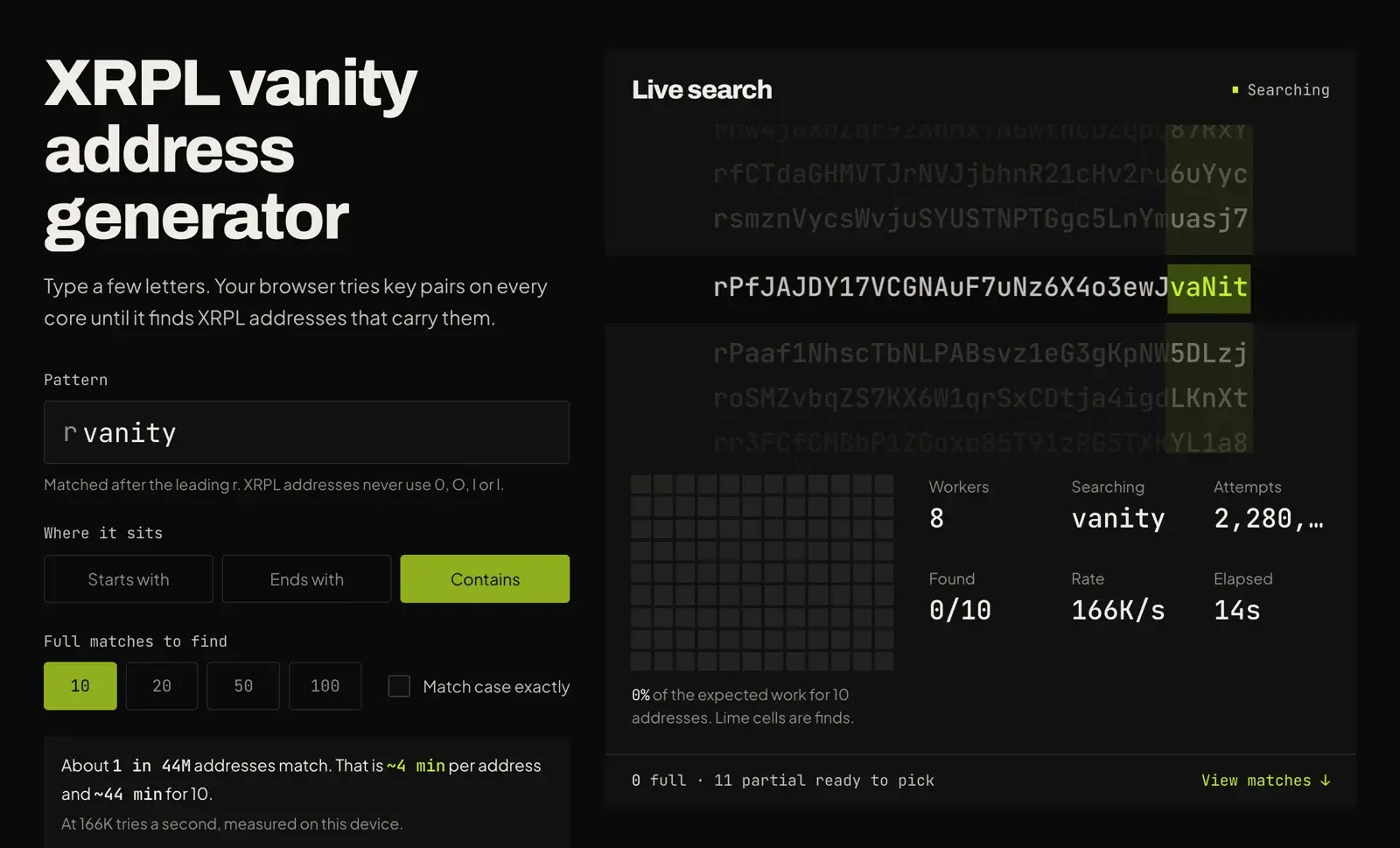
Pick the letters in your XRP Ledger address. The search runs on every core of your machine, inside the browser, and the keys never leave it.
Free · no sign-up · xrpl-vanity.vercel.app
 Open the generator (new tab)
A real result. Pattern “Sys”, anywhere in the address, any case.
What an XRP vanity address is
Every XRP Ledger account has an address: a long base58 string that starts with r. A vanity address, sometimes called a custom XRP address, carries letters you chose. There is no way to request one. The address comes from a random key, so the only way to get the letters you want is to make keys until one lands.
You type up to ten characters, choose whether they go at the start, the end or anywhere, whether case matters, and how many candidates you want. Each match comes back with its address and secret, and you pick the one you like.
The XRPL alphabet has no 0, O, I or l, so the generator turns away patterns that use them instead of searching forever.
Every core, without freezing the page
Making a key is elliptic-curve arithmetic, and the search needs millions of them. Done on the page itself, that would lock the tab. So the page only keeps score, and the work runs in Web Workers: separate threads, one per core, each running our own key engine.
The page
- Takes the pattern and checks it can match
- Adds up attempts from every worker
- Redraws counters and rate five times a second
- Keeps the matches you can choose from
Messages
- → start
- pattern, where it goes, whether case matters
- → stop
- finish the current chunk, report the count
- ← hit
- address and seed, full or partial, sent the moment one fits
- ← progress
- keys tried so far, every 200 ms
- ← stopped
- final count, so no attempt goes uncounted
The workers
Cores minus one, at least 2, at most 8
- 1derive ×64 · test · post
- 2derive ×64 · test · post
- 3derive ×64 · test · post
- 4derive ×64 · test · post
- 5derive ×64 · test · post
- 6derive ×64 · test · post
- 7derive ×64 · test · post
- 8derive ×64 · test · post
Our own key engine
Each worker draws random seeds and derives ed25519 keys 64 at a time. The expensive curve multiplication runs off a precomputed table, and the batch shares one field inversion instead of paying for 64. That took the search from about 18,000 keys a second with xrpl.js to 166,000 on the same laptop. Tests check every seed against xrpl.js Wallet.fromSeed, so a secret you pick restores exactly the address you saw.
Getting closer, without restarts
One pool of workers runs for the whole search, always testing the full pattern. Addresses that carry only part of it come back as partial matches, up to three for each length, so a long search shows progress instead of a spinner. Workers run in 60 ms chunks and yield through a message channel between them, so Stop takes effect almost at once.
How long a vanity address takes
Each letter costs 58 times more. The alphabet has 58 characters, so every extra character multiplies the expected work by 58. These are averages for an exact-case match at the end of the address, at the 166,000 keys a second we measured in Chrome on an M3 Max laptop with eight workers.
Ignoring case or allowing the match anywhere is much faster, which is why “sys” anywhere came back in a second.
| Characters | Keys to try | Time |
|---|---|---|
| 1 | 58 | under a second |
| 2 | 3,364 | under a second |
| 3 | 195,112 | about a second |
| 4 | 11,316,496 | about 68 seconds |
| 5 | 656,356,768 | about 66 minutes |
| 6 | 38,068,692,544 | about 3 days |
Is an XRP vanity address safe?
No server
Keys are made inside the tab from the browser's secure random number generator. There is no backend and no API, and nothing you generate is uploaded. Analytics records visits and how long a pattern was, never the pattern, an address or a secret.
Rekey before real money
A browser tab is not a hardware wallet. Before an address holds real funds, assign it a regular key made on a hardware wallet or an offline machine. The address you chose stays yours, and the key that signs moves somewhere safer. The app says this up front and links the XRPL guide to regular keys.
Questions
- What is an XRPL vanity address?
- An XRP Ledger account address that contains letters you picked, such as a name or a word. It works like any other XRPL address; only the letters differ.
- How do I get a custom XRP address?
- Open the generator, type up to ten characters, choose whether they go at the start, the end or anywhere, and press Generate. When a match comes back, import its secret into an XRPL wallet that accepts a secret (family seed), then fund the address to activate it.
- How long does it take?
- Two or three characters anywhere in the address usually take seconds. When case matters, each extra character multiplies the work by about 58, so on a fast laptop four exact characters take about a minute, five about an hour and six a few days. Ignoring case makes it faster.
- Is an XRP vanity address safe?
- The keys are made in your browser from its secure random number generator and never sent anywhere. For an address that will hold real funds, assign it a regular key made on a hardware wallet or an offline machine, so the key that signs is one no web page has seen.
- Which characters can I use?
- The XRPL base58 alphabet: the digits 1 to 9 and the letters except capital O, capital I and lowercase l. There is no zero. Every address starts with r, and your pattern is matched after it.
- Is it free?
- Yes. No sign-up, no fee and nothing to install.
Find your address
- React 19
- TypeScript
- Web Workers
- ed25519 (@noble)
- Vite
- Vercel
Building on the XRP Ledger?
We work on XRPL, EVM and WASM chains, from wallets and SDKs to indexers. Tell us what you are shipping.